For a Timeline to Be
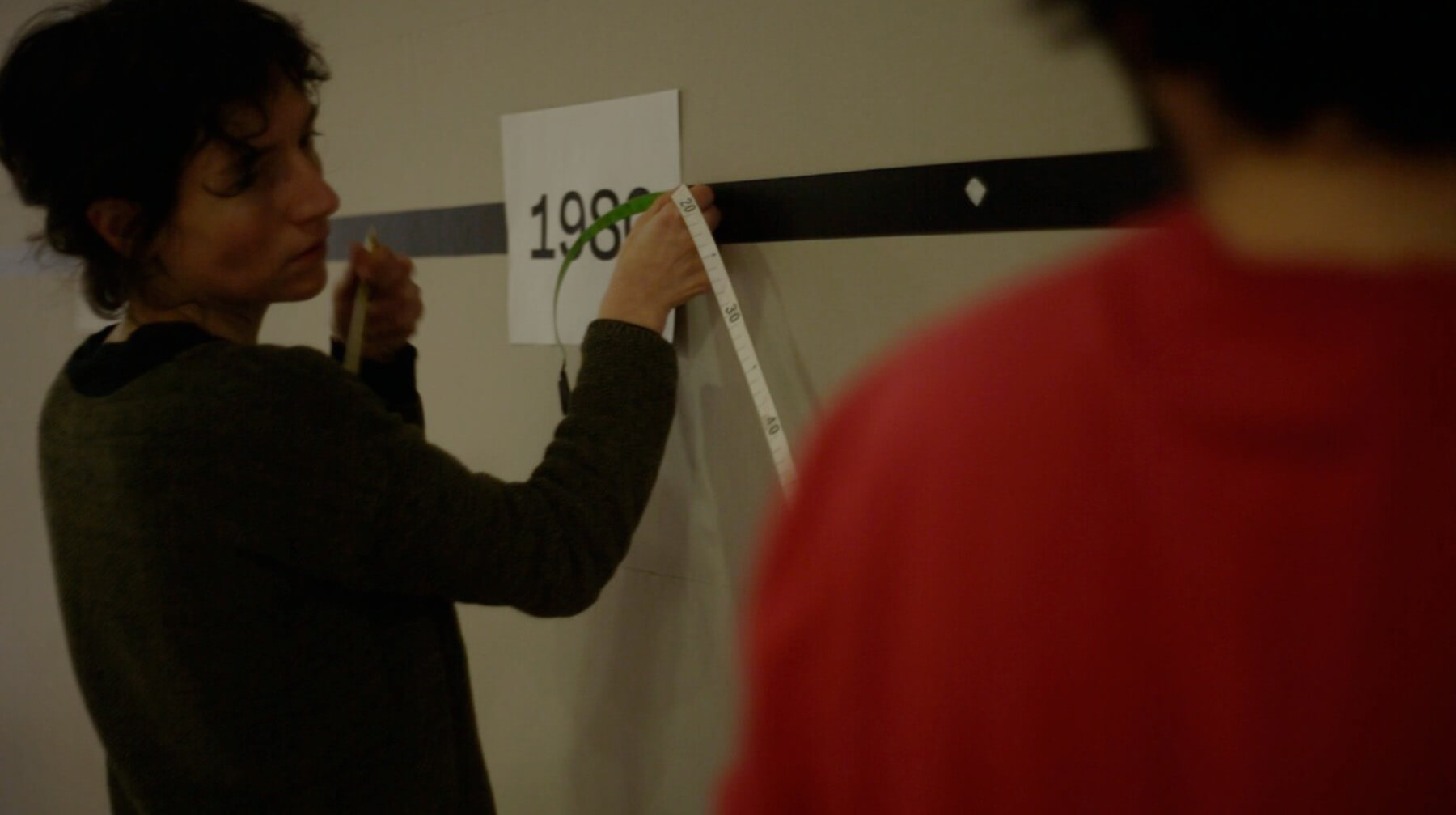
For a Timeline to Be is an exercise in identifying milestones ae nd episodes in the development and dissemination of dance in Portugal. Taking the Portuguese New Dance movement as its point of departure, it interrogates the conditions of its emergence and formation—across both the long and the short durée, spanning the twentieth century and the beginning of the twenty-first.
Conceived and directed by João dos Santos Martins and Ana Bigotte Vieira as a collective artistic and historical research apparatus, the project began within the context of Reencontro, featuring João dos Santos Martins, Vera Mantero, Paulo Ribeiro, Clara Andermatt, and João Fiadeiro, co-produced by Teatro Viriato in 2016. Since then, it has unfolded through seven editions and several working iterations, travelling across Portugal (see below for a detailed description of the different editions).
The project combines bibliographical sources with oral testimonies, the collection of original documents with iconographic research, and the construction of narratives and relationships. It seeks to create a plural space for understanding what dance is—or what it might become—while fostering familiarity with works, authors, canons, corporealities, historical periods, and worldviews, questioning them from both aesthetic and political perspectives.
By bringing together discussions of choreographic discourse alongside the major transformations of Portuguese and international society, the project aims to highlight potential tensions, reveal iconic events and occurrences that generate both consensus and dissent, and promote a comparative analysis informed by the perspectives of decentered modernities and uneven and combined development.
Taking the present as its site of enunciation, each edition undergoes transformations that reconfigure both the physical and methodological framework of what is presented. The project team is continuously reshaped through new collaborations, including:
– Curatorship: artists and researchers Carlos Manuel Oliveira (working editions and the fourth, fifth, and seventh editions) and Ana Dinger (seventh edition);
– Research and writing: Paula Caspão, Rita Luís, Sílvia Pinto Coelho, and Pedro Cerejo;
– Support for individual research projects: Desirée Desmarattes, Diana Niepce, Angela Guerreiro, and Piny;
– Performances, re-enactments, and original commissions: works by Ana Borralho & João Galante; António Olaio, reinterpreted by Vânia Rovisco; Cláudia Dias; Diana Niepce; Francis Graça, revisited by Cristina Graça with students from the Escola Superior de Dança (ESD); Gaya de Medeiros and Ary Zara; João Fiadeiro; Almada, by Luís Guerra; Marlene Monteiro Freitas; Miguel Pereira; Norman Dixon, revisited by André Cabral; Olga Roriz’s work for the Gulbenkian Ballet, restaged by Companhia Nacional de Bailado (CNB); Paula Massano, revisited by Margarida Bettencourt, Ana Rita Palmeirim, Carlos Zíngaro, Paulo Graça, and Nuno Carinhas; Sofia Neuparth; and Vera Mantero’s work, restaged by the CNB. The project has also collaborated with the Escola de Dança do Conservatório Nacional, the Escola Superior de Dança, and the Escola Superior de Teatro e Cinema.
With each exhibition or event, For a Timeline to Be seeks to create the conditions for encounters within an expanded community that understands the past as part of the present, questioning it in ways that open up possible futures and contribute to world-making. A complete list of all collaborators can be found in the project’s Technical Credits (see below).
______________
Alive Dance Archives – Workshop on Tracing, Telling, Retelling, and Making Dance Histories 26.11 — 29.11.2026
The CoFestival – International Contemporary Dance Festival (Ljubljana, Slovenia) and the Temporary Slovenian Dance Archives (Nomad Dance Academy Slovenia, Ljubljana), in collaboration with the project For a Timeline to Be (Parasita Association, Portugal), are organising a series of workshops aimed at archivists, historians, researchers, curators and dance professionals.
The event will take place at Kino Šiška – Centre for Urban Culture, in Ljubljana, from 26 to 29 November 2026, between 11:00 and 17:00. The initiative aims to create a space for presenting and sharing knowledge, as well as for discussing challenges and comparing methodologies relating to the digital and physical archiving of research projects linked to the history and historiography of dance, selected via an open call.
Applications are open until 7 September 2026. Interested parties should submit a proposal (maximum one page), accompanied by a brief biography, a description of the project or research, and links to relevant work, to rok.vevar@gmail.com and anabigottevieira@gmail.com, with the subject line “Alive Dance Archives – proposal”.
Further information about the project and the call for proposals is available here.


⌂ TECHNICAL INFO
Curatorship, research and edition: Ana Bigotte Vieira, João dos Santos Martins and Carlos Manuel OliveiraReserach support: Pedro Cerejo, Sílvia Pinto Coelho
Design: Ana Schefer e Teo Furtado
Set up: Pedro Lagoa
Production: Associação Parasita
Supports: República Portuguesa: Cultura/ DGArtes Direção-Geral das Artes, Fundação Calouste Gulbenkian, Teatro Sá da Bandeira - Santarém, Teatro Viriato, Livraria Tigre de Papel
Partnerships: Instituto de História Contemporânea, Centro de Estudos de Teatro
Acknolodgements: Paula Caspão, Maria José Fazenda, Daniel Tércio, Maria João Brilhante, Luísa Roubaud
Contributors: Alexandra Balona, Ana Cristina Vicente, Ana Mira, André e. Teodósio, António Cascais, António Laginha, Cristiana Rocha, Cristina Grande, Cristina Santos, Daniel Tércio, Duarte Bénard da Costa, Elisabete Paiva, Ezequiel Santos, Gil Mendo, Joclécio Azevedo, Luísa Roubaud, Magda Henriques, Margarida Bettencourt, Maria José Fazenda, Mariana Brandão, Mariana Pinto dos Santos, Mónica Guerreiro, Paula Caspão, Rita Natálio, Rogério Nuno Costa, Sílvia Pinto Coelho, Tiago Bartolomeu Costa